
Marionette lines can make the lower face look tired, tense, or downturned even when you feel perfectly rested. The best treatments for marionette lines are rarely about filling one crease alone. A refined result comes from understanding the volume loss, skin quality, muscle movement, and facial structure contributing to the line in the first place.
These lines run from the corners of the mouth toward the chin. They tend to become more noticeable as collagen declines and the cheeks, jawline, and tissues around the mouth gradually lose support. For some people, the concern is subtle and appears only with expression. For others, the folds remain visible at rest and affect the balance of the entire lower face.
The right approach should leave you looking refreshed, not overfilled or unlike yourself. That is why a thoughtful consultation matters as much as the treatment itself.
Why Marionette Lines Form
Marionette lines are often blamed on aging skin, but their cause is more layered than that. Over time, the face naturally loses fat, collagen, elastin, and bone support. The midface may flatten, the jawline can become less defined, and skin around the mouth may begin to fold downward.
Repeated facial movement also plays a role. Muscles that pull the corners of the mouth down can make a shadow or crease look more pronounced. Genetics, sun exposure, weight fluctuations, smoking, and skin dehydration may accelerate these changes.
This is why two people with similar-looking lines may need very different treatment plans. One person may benefit most from strategic cheek support; another may need subtle filler at the mouth corners, improved skin density, or treatment for downward muscle pull.
Best Treatments for Marionette Lines
Dermal Fillers for Immediate Structural Support
For many clients, hyaluronic acid dermal filler is the most direct and effective option for softening marionette lines. These gel-based fillers can restore lost volume, smooth a crease, and create more support around the corners of the mouth and lower face.
The most natural approach does not always mean placing filler directly into the deepest part of the line. In fact, treating only the crease can sometimes create a heavy or puffy appearance. A skilled injector may instead begin by restoring support in areas such as the cheeks, chin, jawline, or prejowl hollow, then use a conservative amount of filler around the marionette area if needed.
Results are visible right away, although mild swelling or bruising can occur for several days. Depending on the product used, your metabolism, and the treatment area, results may last roughly six months to well over a year. Hyaluronic acid filler also has an advantage many clients appreciate: it can be adjusted or dissolved if medically necessary.
Filler is especially well suited to lines caused by volume loss or a lack of lower-face support. It may be less satisfying as a stand-alone answer when loose skin and significant tissue descent are the primary concerns.
Botox or Dysport for a Downturned Mouth Appearance
If the corners of your mouth pull downward, Botox or Dysport may complement filler beautifully. These neuromodulators can relax the depressor anguli oris muscle, often called the DAO, which contributes to a downturned mouth expression.
This treatment does not fill a fold or replace lost volume. Instead, it can soften the muscular pull that deepens the marionette area and creates a more relaxed lower-face expression. The change is subtle, which is exactly the point. You should still look like yourself, simply more at ease.
Results generally develop over several days and last about three to four months. Precise placement is essential in this area because the muscles around the mouth are involved in speech, eating, and expression. This is a treatment that calls for experienced, conservative administration.
PRF for Gradual, Natural-Looking Rejuvenation
Platelet-rich fibrin, or PRF, is an appealing option for clients who want to support collagen production using their own biologic material. PRF is created from a small sample of your blood and contains platelets, fibrin, and growth factors that can encourage skin renewal over time.
When used around the lower face, PRF may help improve fine creasing, skin quality, and the overall softness of the area. It is not a replacement for filler when a deep marionette fold needs structural correction, but it can be an excellent addition for clients who want a gradual, regenerative approach.
PRF results develop over a series of treatments and are more subtle than the immediate change from filler. The payoff is skin that can look smoother, healthier, and more resilient rather than simply filled. For early marionette lines or clients focused on skin quality, that distinction can be meaningful.
Microneedling for Crepey Texture and Fine Lines
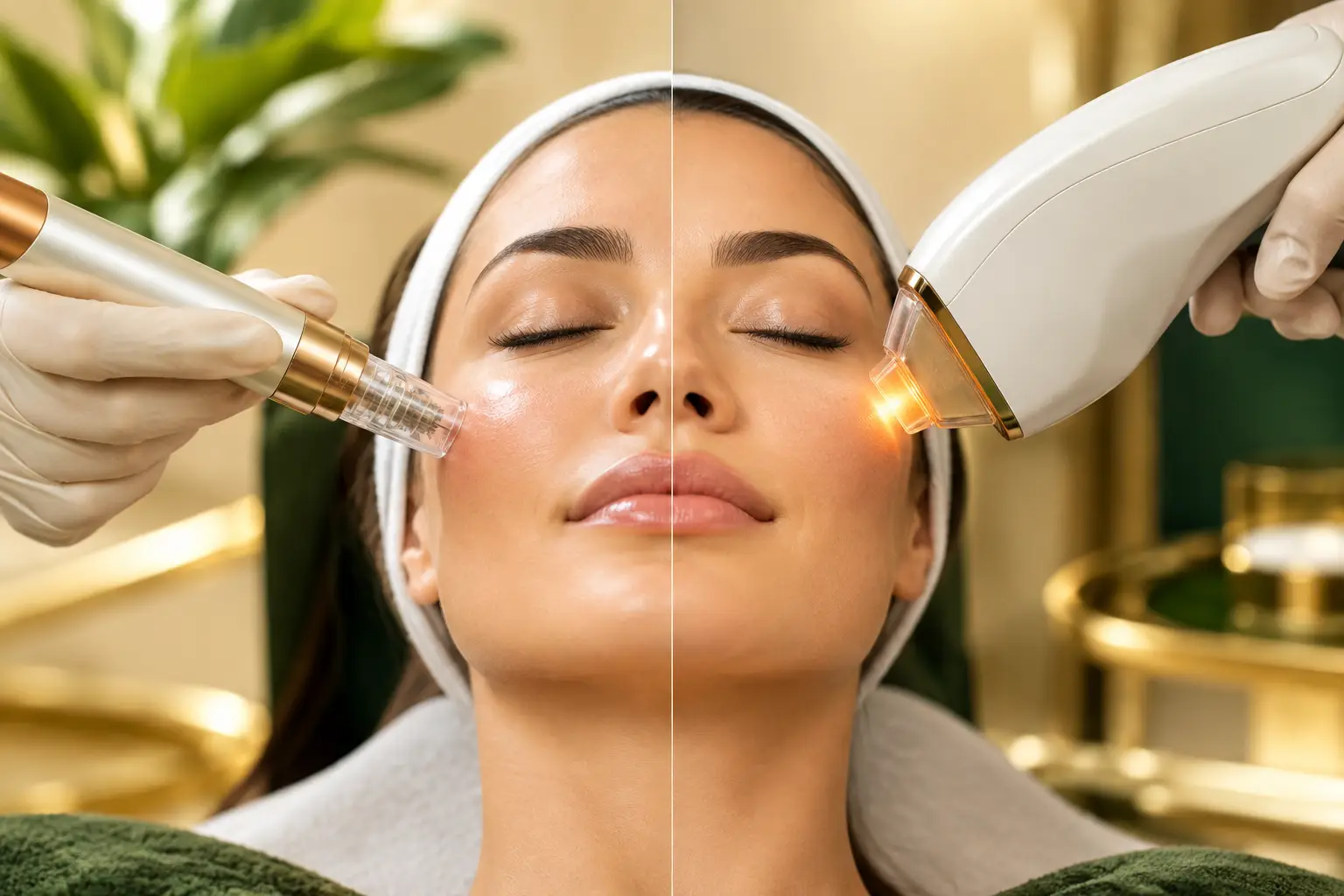
When marionette lines are accompanied by thin, crepey, or uneven skin, microneedling can help improve the canvas. The treatment creates controlled microchannels in the skin, stimulating the body’s collagen and elastin response. It can be performed on its own or enhanced with PRP or PRF, depending on your treatment plan.
Microneedling will not lift sagging tissue or replace meaningful volume loss. It is best viewed as a skin-strengthening treatment. Over a series of sessions, it may soften fine lines, refine texture, and help the lower face appear smoother and more luminous.
Expect temporary redness after treatment, much like a mild sunburn. Most clients return to normal activities quickly, while giving the skin time to fully recover and build new collagen.
Thread Lifts for Mild Lower-Face Laxity
A thread lift can be considered when mild sagging in the cheeks or lower face is creating more pronounced marionette lines. Absorbable threads are placed beneath the skin to provide a gentle lifting effect while also stimulating collagen production over time.
Threads are not a substitute for a surgical facelift, and it is important to have realistic expectations. They can be valuable for the right candidate who wants more support than filler alone may provide without the downtime of surgery. The result is typically most flattering when it is subtle, with improved contour rather than an obvious pull.
A thread lift may be paired with filler, PRF, or skin treatments to address both tissue position and skin quality. The best combination depends on how much laxity is present and whether volume loss is also contributing to the concern.
Why Combination Treatment Often Looks Best
The lower face is interconnected. A crease beside the mouth may begin with volume loss higher in the face, while a downturned expression may be driven by muscle activity and a lack of chin or jawline support. Treating only the visible line can miss the reason it formed.
A personalized plan may combine structural filler with a small amount of Botox or Dysport for mouth-corner pull. PRF or microneedling may then support collagen and texture over time. This layered approach can create a polished result that still feels light, natural, and expressive.
Not everyone needs multiple treatments. A younger client with early lines may be delighted with skin-focused care and a modest amount of filler. Someone with more advanced laxity may need to discuss whether non-surgical options can meet their goals or whether surgery would provide a more appropriate level of correction.
What to Expect From Your Consultation
A quality consultation should include more than a close look at the lines themselves. Your provider should assess your facial proportions at rest and in motion, skin thickness, volume distribution, jawline support, and the way your mouth corners move.
You should also discuss your timeline, budget, comfort with maintenance, and desired level of change. Some treatments offer an immediate improvement but require periodic upkeep. Others build gradually and may require a series. There is no single best option for every face, only the option that best respects your features and goals.
Be open about prior filler, allergies, medications, health conditions, and any history of cold sores or cosmetic procedures. A trained medical aesthetics provider can help determine what is appropriate and explain potential side effects, including swelling, bruising, tenderness, asymmetry, and the rare but serious risks associated with injectable treatment.
At YouShine Med Spa, the goal is never to chase a perfectly smooth lower face. It is to create balance, softness, and confidence with a plan designed around you. When marionette lines are treated with restraint and expertise, the most beautiful result is often the one people notice only as a more rested, radiant version of you.